“That’s not fair!” In many households, this is the common refrain of children as they advocate for themselves or express what they feel to be unjust. This pursuit of fairness, however, is not limited to arguments between parents and young children.
The notion of fairness often pervades family dynamics and may continue even beyond death when decisions about dividing accounts and property arise. The law has attempted to address different notions of fairness with a variety of distribution strategies. Per stirpes, by representation, and per capita are key terms in wills and trust agreements that specify the way money and property are to be equitably divided. As you explore these distribution methods, observe how they achieve fairness in different ways and with different results.
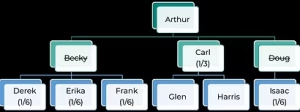
To best understand how these distribution strategies work, it is important to start with the basics. For the purpose of this discussion, let us focus only on the children who belong to both parents. In the simplest and most straightforward case, when a parent dies and the deceased parent’s accounts and property are divided among the children, the children split everything equally. This is the most basic inheritance distribution principle. Sometimes, however, grown children predecease their parents, leaving behind children of their own. Per stirpes, by representation, and per capita distribution are best understood in such contexts where grandchildren are relevant parties due to the death of a child.
Per Stirpes Distribution
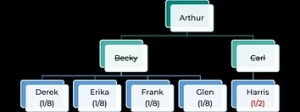
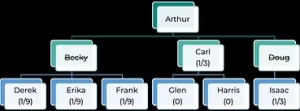
By Representation Distribution
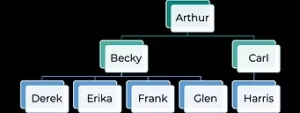
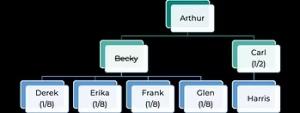
If all of Arthur’s children predecease him, the first generation that would have inherited Arthur’s property and accounts is gone. Under by representation distribution, Arthur’s accounts and property would then be distributed equally among the grandchildren rather than based on what their parents were to inherit. Essentially, there is an even redistribution among the second generation.
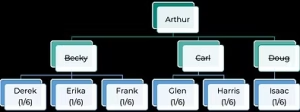
Per Capita at Each Generation Distribution